Every safety shoe must withstand a 20 kg weight striking the toe. Depending on the marking, it must also resist a nail from below, keep water out or insulate against cold. All of this is tested in a lab before the shoe is allowed to carry its marking. Here we go through how the tests are done, and what the figures on the marking actually mean.
If you first want to know what the safety classes and markings stand for, start with our Guide to safety footwear.
EN ISO 20345 and 20344: the requirements and the tests
The requirements for a safety shoe are set out in EN ISO 20345. It states, for example, how much space the toes must have left after an impact. How the tests are to be carried out is set out in a separate standard, ISO 20344. It describes everything from how heavy the falling weight is to how long the shoe must stand in water.
Most tests are carried out on several sizes, often the smallest, middle and largest in the range. A large shoe and a small shoe must protect equally well.
Once the shoe has passed the tests, a notified body issues an EU type-examination certificate. The certificate is valid for a maximum of five years and must then be renewed.
The toe cap: what does 200 joules mean?
The toe cap is tested with an impact of 200 joules. That corresponds to a 20 kg weight falling about one metre straight down onto the toe.
The front part of the shoe is cut off, and a small piece of modelling clay is placed under the toe cap. When the weight strikes, the cap is compressed and the clay with it. The height of the clay afterwards shows how much space your toes would have had left.
Then the same is done in a press. The cap must withstand 15 kN, about 1.5 tonnes, and even then the toes must have space left.
The toe cap
Included in all safety footwear (SB–S7)
Choose size:
At least 14.0 mm of space left for the toes
Impact: 200 joules
A 20 kg weight falls about one metre onto the toe. The cap must not crack through.
Compression: 15 kN
The cap is compressed with about 1.5 tonnes. The same clearance requirement applies afterwards.
Size (EU)
Minimum clearance after impact and compression
36 and smaller
12.5 mm
37–38
13.0 mm
39–40
13.5 mm
41–42
14.0 mm
43–44
14.5 mm
45 and larger
15.0 mm
Nor may the cap crack through. The requirement is the same whether the toe cap is made of steel, aluminium or composite. You can read about the difference between the materials in Steel toe cap shoes?
Penetration resistance: one nail, four points
The penetration-resistant midsole is tested with a standardised nail that is pressed up through the sole. It must take at least 1,100 N for the nail to go through, roughly the weight of 110 kg.
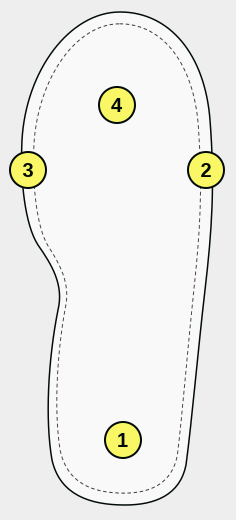
The upper is removed, and the nail is pressed slowly against the sole from below. This is done in four places: at least one in the heel and two near the edge of the sole. Soles made of leather and other materials that absorb water are soaked for 16 hours before the test.
Penetration resistance
A standardised nail is pressed up through the sole at four points
1The heelAt least one point in the heel
23Near the edge10–15 mm in from the edge of the sole, in the dashed zone
4The forefootAt least 30 mm between all points
P
Metal
At least 1,100 N at all four points
PS
Non-metal
At least 1,100 N on average, no point below 950 N
PL
Non-metal
The nail must not go through at 1,100 N
The three types of penetration-resistant midsole are assessed in different ways:
Metal (P): it must take at least 1,100 N for the nail to go through.
Non-metal, type PS: the average of the four points must be at least 1,100 N, and no point may be below 950 N.
Non-metal, type PL: the nail is pressed with 1,100 N and must not go through anywhere.
The midsole must also withstand one million flexes without cracking. The test shows what the protection can withstand against a standardised nail. A thinner nail or a heavier load increases the risk of something penetrating, whatever the type.
Are there slip-proof shoes?
No, no shoe is completely slip-proof. But all safety footwear is slip-tested on ceramic tile with a soap solution, and shoes marked SR have also passed the same test with glycerine. Glycerine is considerably more slippery and corresponds to oily and greasy floors.
The test measures a coefficient of friction, in other words how well the shoe grips the floor. Two movements are tested: the heel sliding forwards and the forefoot sliding backwards.
Test
Surface
Heel forwards
Forefoot backwards
Basic test, all safety footwear
Ceramic tile with soap solution
At least 0.31
At least 0.36
SR, slip resistance on oily surfaces too
Ceramic tile with glycerine
At least 0.19
At least 0.22
The SR requirements look lower because glycerine is so much more slippery. It is the test that is harder, not the requirement that is lower.
The test is carried out on a new shoe, and grip changes as the sole wears. Nor does it replicate loose ground such as mud and gravel.
Waterproof safety footwear: S3 or S7?
The difference between S3 and S7 lies in the water test. For S3, a piece of the upper material is tested. For S7, the whole shoe is tested as well, seams, sole and all. What is called waterproof in everyday speech is called water resistance (WR) in the standard.
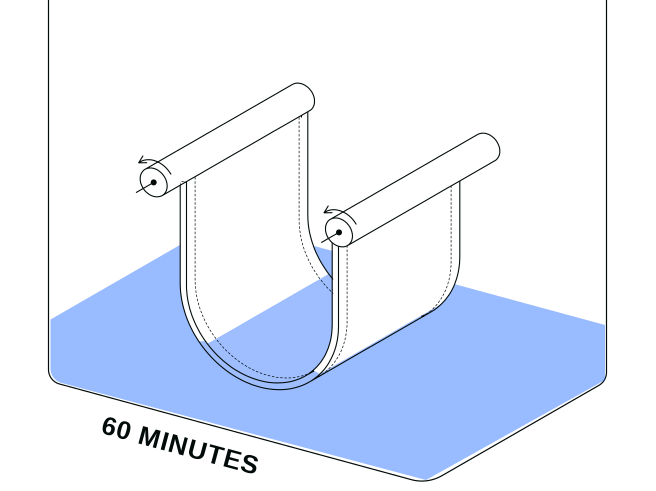
S3: the material. A piece of the upper is clamped in a machine that flexes it, with the outside in water, for 60 minutes. No more than 0.2 grams of water may penetrate, and the material may absorb no more than 30 per cent of its weight.
S7: the whole shoe. There are two ways to test this:
The trough. A person walks 100 lengths in a trough with 3 cm of water, at about ten steps per length. That makes around 1,000 steps in the water.
The flexing machine. The shoe is fitted on a foot form and flexed at the ball of the foot, 60 times a minute for 80 minutes, with water 2 cm above the join between sole and upper. That makes 4,800 flexes.
Afterwards, the inside is checked by hand and with absorbent paper. No water may have got in.
S3
Upper material (WPA)
60 minutes in a flexing machine
A piece of the upper is flexed with the outside in water. Seams and sole are not included.
No more than 0.2 grams of water through
S7
The whole shoe (WR)
100 lengths in a water trough
A person walks around 1,000 steps in the water. The alternative is a flexing machine for 80 minutes.
No water may get in
An S7 shoe has passed both tests: first the material, then the whole shoe.
If you work a lot in water, wet terrain or slush, S7 is worth choosing. We write about snow and slush in Winter safety footwear.
Heat and cold: from −17 to 300 degrees
Three markings are about temperature, but they measure different things. CI and HI show how well the sole insulates the foot. HRO shows whether the sole can withstand contact with something hot.
CI −17 °C
HI 150 °C
HRO 300 °C
0 °C100 °C200 °C
CI
Cold-insulating sole
−17 °C for 30 minutes
The shoe stands on a copper plate in a cold chamber.
No more than 10 degrees colder inside the shoe
HI
Heat-insulating sole
150 °C for 30 minutes
The shoe stands on a hot plate, surrounded by sand.
No more than 22 degrees warmer inside the shoe
HRO
Resistance to hot contact
300 °C for 1 minute
A hot metal body is pressed against the sole, which is then flexed.
Must neither melt nor crack
CI, cold-insulating sole. The shoe is filled with steel balls, which act as the foot, and placed on a copper plate in a cold chamber at −17 °C. After 30 minutes, the temperature inside the shoe may have dropped by no more than 10 degrees.
HI, heat-insulating sole. The shoe is filled with steel balls and placed on a plate heated to 150 °C, surrounded by sand, for 30 minutes. The temperature inside the shoe may rise by no more than 22 degrees. Afterwards the shoe is inspected, and the sole must not, for example, have developed deep cracks or come away from the upper.
HRO, sole resistant to hot contact. A metal body heated to 300 °C is pressed against a piece of the sole for one minute. Once the piece has cooled, it is bent around a thin rod. The sole must neither melt nor crack.
So HRO shows that the sole can withstand brief contact with something hot, not that you can stand on a hot surface for any length of time. For work in the cold, read more in Winter safety footwear.
Electrical properties: antistatic and partially conductive
The shoe’s electrical resistance is measured through the whole shoe, from the inside down to the floor. An antistatic shoe (A) must pass the test in both dry and humid air, because moisture affects the result.
Before the test, the shoe is stored for a week in dry air. An antistatic shoe is also stored for a week in humid air. It is then filled with 4 kg of small steel balls, placed on a copper plate and subjected to 100 volts for one minute. The insole stays in place, just as when you wear the shoe.
Marking
Resistance
Tested after
A, antistatic
Between 100 kΩ and 1,000 MΩ
Dry and humid air
C, partially conductive
No more than 100 kΩ
Dry air
A shoe can be antistatic or partially conductive, never both. Partially conductive shoes are used where charge must be conducted away quickly, for example when handling explosives.
Neither of them is electrically insulating. They are not suitable for work on live installations. ESD shoes for electronics are tested to a different standard, which you can read about in our guide to ESD shoes.
The wear trial: three people, not a single no
Before a safety shoe is approved, it is also tried by three people with different foot sizes. All of them must answer yes to every question, otherwise the shoe fails.
The three walk for five minutes at a normal pace, go up and down a flight of stairs, and kneel and crouch. Then they answer questions:
Is the inside free from rough, sharp or hard areas that rub?
Is the shoe free from features that could catch or make you trip, such as buckles or straps?
Can the fastening be adjusted properly?
Can you walk, climb stairs and kneel without problems?
On shoes with a scuff cap (SC), it is also checked that the cap prevents the upper from rubbing against the ground when you kneel. The scuff cap is also abrasion-tested in a machine and must withstand 8,000 cycles without wearing through.
The wear trial is the only test in which people assess how the shoe feels to wear. It says something important: a safety shoe should not only protect, it should be possible to work in.
What the tests do not show
The tests are carried out on new shoes in a lab, under exactly the same conditions every time. That makes shoes comparable, but reality at work looks different.
Wear. Grip changes as the sole wears, and cracks or a sole that comes away can reduce the protection. Check your shoes regularly. You can read about when it is time to replace them in our Guide to safety footwear.
The insole. The shoe is tested with its own insole in place. So only replace it with the same insole from the manufacturer.
Your workplace. No test replicates every surface and risk. Choose shoes based on the risk assessment of the workplace, not just on the marking.
Frequently asked questions
What does 200 joules mean on a safety shoe?
The toe cap is tested with an impact of 200 joules, which corresponds to a 20 kg weight falling about one metre. After the impact, the toes must have at least 12.5–15 mm of space left, depending on size.
How much must a penetration-resistant midsole withstand?
The limit is 1,100 N, roughly the weight of 110 kg. For metal midsoles and type PS, it must take at least that much for a standardised nail to go through. For type PL, the nail must not go through at all at 1,100 N.
How is waterproof safety footwear tested?
Shoes marked S6 and S7 are tested as a whole shoe, either by a person walking 100 lengths in a trough with 3 cm of water or in a machine that flexes the shoe in water for 80 minutes. No water may get in. The standard calls it water resistance (WR).
What is the difference between the slip test and SR?
All safety footwear is slip-tested on ceramic tile with a soap solution. SR means the shoe has also passed the test with glycerine, which corresponds to oily and greasy floors.
How cold is the CI test?
The shoe stands in a cold chamber at −17 °C for 30 minutes. The temperature inside the shoe may drop by no more than 10 degrees.
What temperature can an HRO sole withstand?
The HRO sole is tested with a metal body heated to 300 °C for one minute and must neither melt nor crack. This shows resistance to brief contact, not to long periods on a hot surface.
Is there slip-proof safety footwear?
No, no shoe is completely slip-proof. All safety footwear is slip-tested on ceramic tile with a soap solution, and shoes marked SR have passed the test with glycerine as well. Grip changes as the sole wears.
What is the difference between EN ISO 20345 and 20344?
EN ISO 20345 sets out the requirements a safety shoe must meet, for example how much space the toes must have left after the impact. ISO 20344 describes how the tests are carried out.
Behöver du hjälp att välja?
Hitta en återförsäljare nära dig som kan visa skorna.
We are currently working on upgrading the Partner Portal with new features and an improved user experience. During this time, the portal will be temporarily unavailable.
We apologise for any inconvenience this may cause and are happy to assist you via email: