All safety shoes have a toe cap, but it is not always made of steel. The toe cap can be steel, aluminium or composite. All three must meet the same requirements in the EN ISO 20345 standard: an impact of 200 joules and a compression of 15 kilonewtons. Most Arbesko safety shoes have an aluminium toe cap.
Steel toe cap is the everyday name for the toe cap, the built-in protection over the toes in a safety shoe. The standard simply calls it a toe cap, and it can be made of steel, aluminium or composite.
According to EN ISO 20345, the toe cap must:
protect against an impact of 200 joules and a compression of 15 kilonewtons
leave a minimum space under the cap after the tests, so the toes are not crushed
be permanently built into the shoe and not crack through during the tests
The requirement applies to all safety classes, from SB to S7, for shoes, boots and rubber boots alike. The safety class tells you what the shoe has in addition to the toe cap, such as an antistatic sole, a water-resistant upper or a penetration-resistant midsole. The material of the toe cap is not shown in the marking.
Steel, composite or aluminium?
All three meet the same requirements, so the choice depends on your working day: how much you walk, whether you pass metal detectors and how cold it is.
Steel
Composite
Aluminium
Protection
200 J impact, 15 kN compression
200 J impact, 15 kN compression
200 J impact, 15 kN compression
Weight
Heaviest
Light, metal-free
Lighter than steel
Metal detectors
Metal, may trigger them
The Tech models do not trigger metal detectors
Metal, may trigger them
Size of the cap
Thin
Often thicker for the same protection
Thinner than composite
Suits
Classic shoes, clogs and boots
Light, sporty shoes and work with metal detectors
Most jobs, when you want light protection in a slim shoe
At Arbesko
Bredsjö, Kiruna 835 and 837, safety clogs, rubber boots
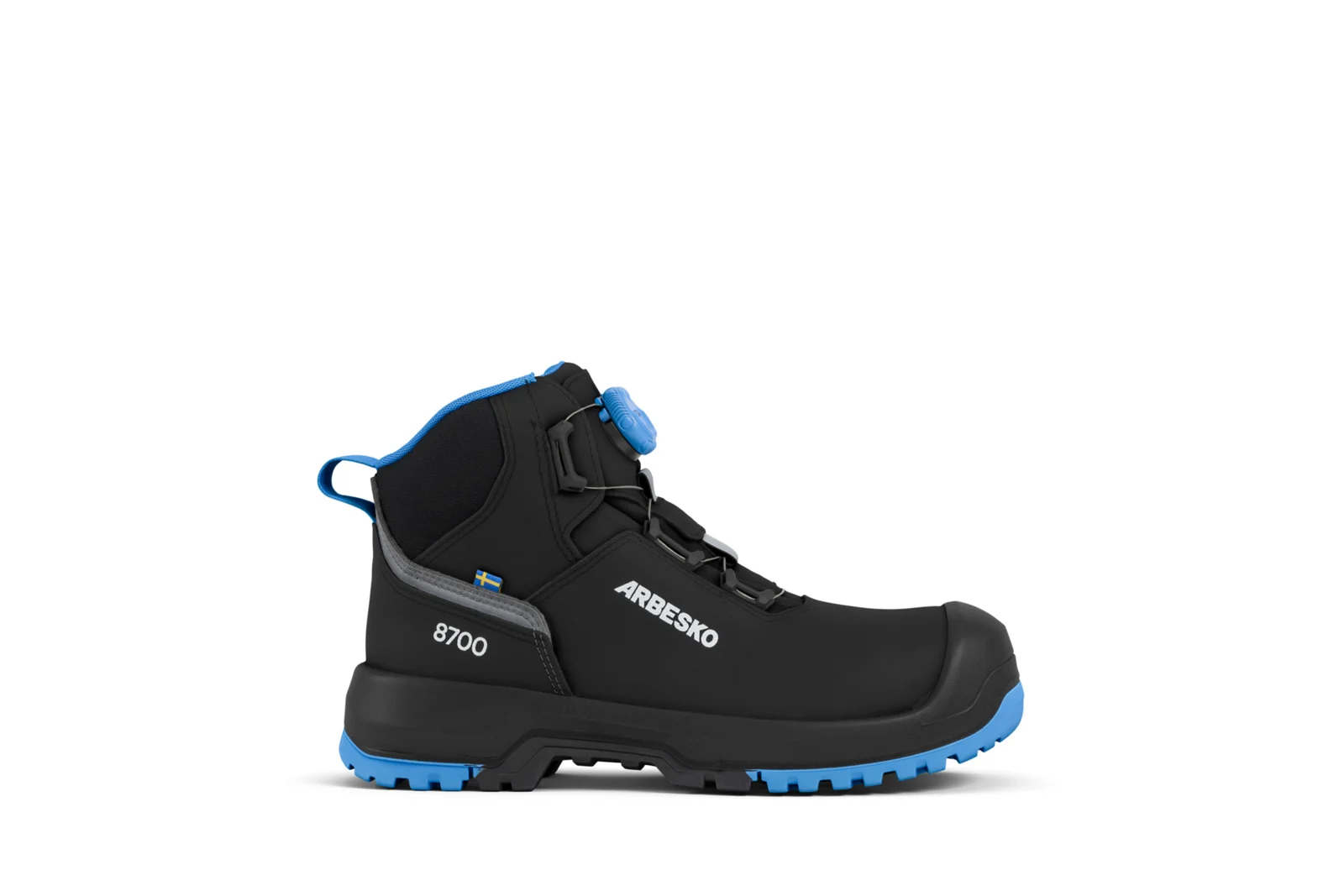
Most others, for example Kiruna 8700, Umeå and A-Series
Warm toes? Cold insulation is tested on the sole, not on the toe cap. If you want a warm shoe, choose a model marked CI (cold-insulating sole), whatever the toe cap material.
The standard gives non-metal caps a little more room: the flange may be at most 15 mm wide, compared with 12 mm for metal.
Safety shoe or occupational shoe?
An occupational shoe has no toe cap. Occupational shoes are certified to EN ISO 20347 and marked OB to O7. They have the same requirements as safety shoes for things like slip resistance and soles, but no requirement for toe protection.
Safety shoes are certified to EN ISO 20345 and marked SB to S7. Only they have a toe cap.
An occupational shoe suits places with no risk of falling or heavy objects, for example in healthcare, kitchens or light warehouse work. If your toes need protection, choose a safety shoe. Arbesko has both, for example the occupational sneaker Tech 1101 and the safety shoe Tech 2302.
Is a steel toe cap required?
No, there is no requirement for steel. The standard sets the same requirements for the toe cap whatever the material, and since EN ISO 20345 is a European standard, the requirements are the same throughout Europe.
Whether you need safety shoes at all is decided by your employer’s risk assessment. The rules differ between countries, but within the EU they are based on a common directive: the employer is responsible for making sure you have the protective equipment you need. Check the rules that apply in your country. The risk assessment shows which risks exist, for example falling objects, nails or slipping, and which safety class is needed. How to choose a class is explained in our Guide to safety footwear.
Once the safety class is set, choose the toe cap material based on your working day:
Do you pass metal detectors? Choose a model without metal, such as the Tech series.
Do you walk a lot? A light cap in aluminium or composite makes a difference over a whole day.
Do you work in the cold? Look for the CI marking. It says more about warmth than the toe cap material does.
How should the shoe fit around the toes?
Your toes should have room to move without touching the toe cap. A cap that presses will chafe within a few hours.
Three tips when trying shoes on:
Try them with the socks you wear at work.
Try them late in the day, when your feet are at their largest.
Take a few steps and flex your foot. Check that the edge of the cap does not press on your toes.
The standard requires the toe cap to have a minimum internal length and a remaining space under the cap after the impact and compression tests. That space is a laboratory requirement, not a measure of how the shoe should fit.
EU size
Minimum internal length of the cap
Minimum clearance after testing
36 and smaller
34 mm
12.5 mm
37–38
36 mm
13.0 mm
39–40
38 mm
13.5 mm
41–42
39 mm
14.0 mm
43–44
40 mm
14.5 mm
45 and larger
42 mm
15.0 mm
Toe caps for different needs
Winter
For cold working days, a cold-insulating sole (CI) is what counts. Kiruna 835 is a boot and Kiruna 837 a high-leg boot, both S7S with a steel toe cap and CI. If you want a lighter cap, there are Kiruna 8700 and 8710 with aluminium, and Tech 2715 and 2720 with composite, all S7S with CI.
Why steel in Kiruna 835 and 837? The boots have a double lining of PrimaLoft® Bio™ and wool that keeps your feet warm in severe cold. That calls for an extra wide fit, and at that width a steel toe cap is what fits. The bonus is room for thicker socks.
Kiruna 835 Steel toe cap S7S, CI, HI, HRO, FO, SR See Kiruna 835Kiruna 8700 Aluminium toe cap S7S, CI, HI, FO, SC, LG, HRO, SR See Kiruna 8700
Looking for sneakers with a steel toe cap? Arbesko’s sporty safety shoes in the Tech series have a composite toe cap instead. It is metal-free and gives the same protection against impact and compression. The Tech models do not trigger metal detectors either.
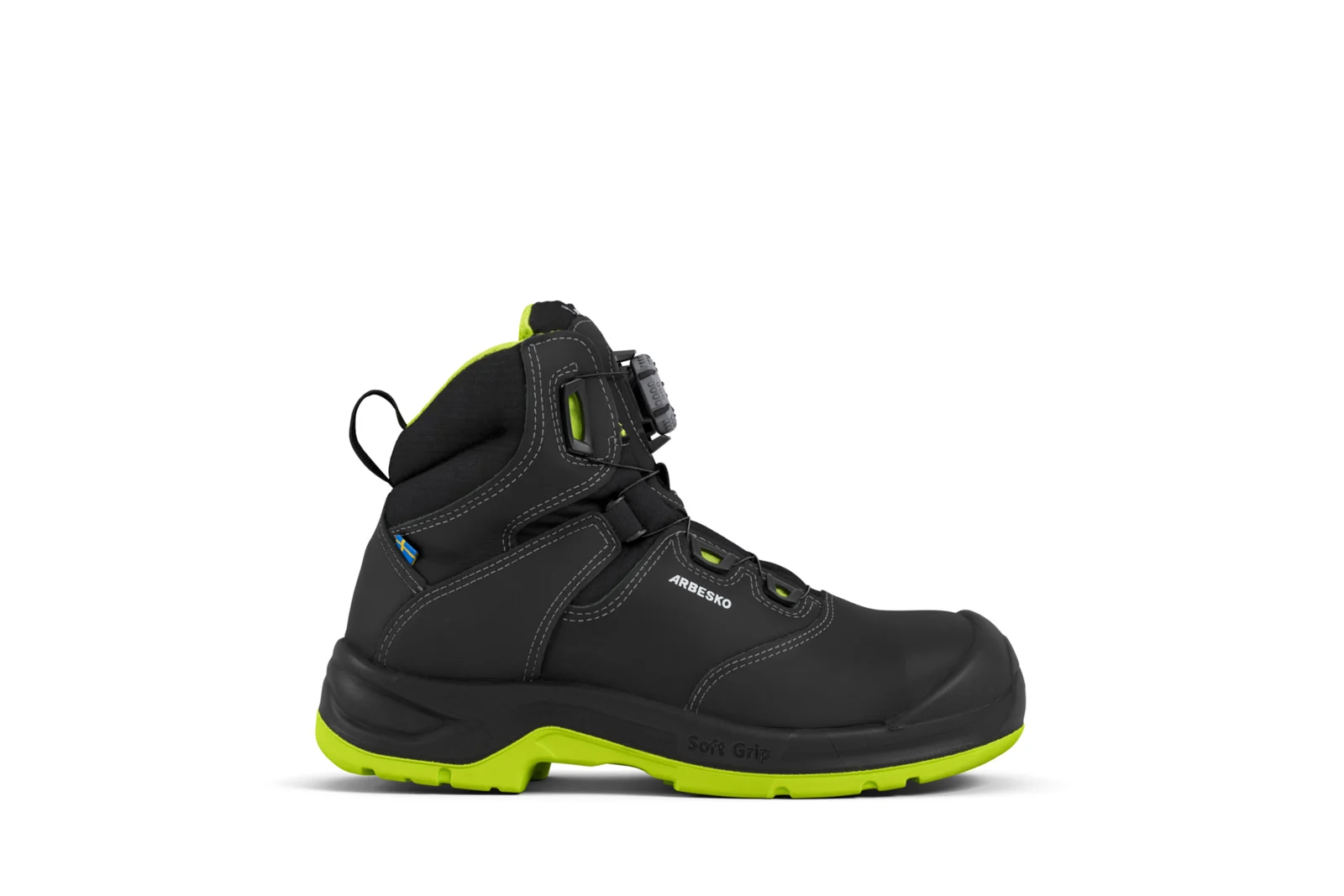
How soft a safety shoe feels depends on the upper, cushioning and sole, not on the toe cap material. The Umeå series has soft leather and an aluminium toe cap for people who stand and walk a lot, for example the Umeå 949 boot.
The 187 and 191 safety clogs have a steel toe cap and are rated SB with an antistatic sole and shock-absorbing heel. They suit jobs where you need to get them on and off quickly, for example in industry and workshops. Arbesko’s occupational clogs have no toe cap.
Classic steel
The Bredsjö series has a steel toe cap and comes as the 612 and 632 shoes and the 635 boot, with a sole that resists contact heat (HRO).
Frequently asked questions
Do all safety shoes have a steel toe cap?
No. All safety shoes have a toe cap, but it can be steel, aluminium or composite. Most Arbesko safety shoes have an aluminium toe cap.
Does steel protect better than aluminium or composite?
No. All toe caps in safety shoes must pass the same tests under EN ISO 20345: an impact of 200 joules and a compression of 15 kilonewtons.
Do shoes with a composite toe cap trigger metal detectors?
The composite toe cap contains no metal. What matters is whether the rest of the shoe has metal, for example a steel penetration-resistant midsole. Arbesko’s Tech models do not trigger metal detectors.
Are there steel toe cap shoes in women’s sizes?
Many models come from size 35, for example Kiruna 835 and the 187 safety clog.
When should I replace shoes with a toe cap?
Check the shoe before you put it on. Replace it if the toe cap shows through from wear, if there are sharp edges from the toe protection, or if the sole and upper have started to come apart. The full list is in our Guide to safety footwear, with care tips in our shoe care guide.
We are currently working on upgrading the Partner Portal with new features and an improved user experience. During this time, the portal will be temporarily unavailable.
We apologise for any inconvenience this may cause and are happy to assist you via email: