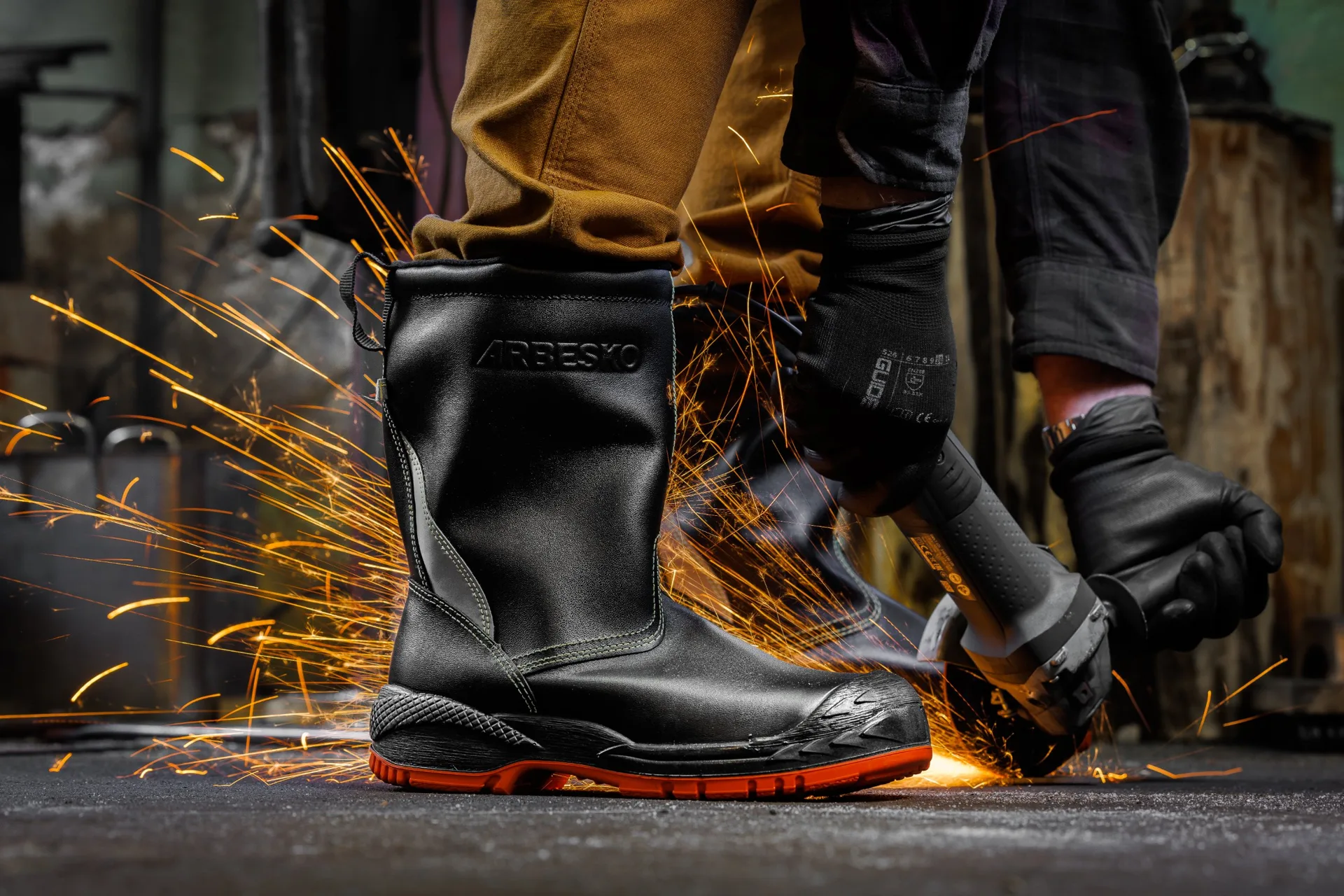
Where there is molten metal, welding spatter and hot surfaces, an ordinary safety shoe is not enough. Safety footwear for foundry and welding is tested to its own standard, EN ISO 20349, which sets requirements for both the materials and how the footwear is built. Here we explain what the standard requires, what the markings mean and how to choose.
EN ISO 20349 is the standard for safety footwear that protects against heat and molten metal. It has two parts: part 1 covers foundries and large amounts of molten metal, part 2 covers welding and related work with small metal splashes.
Footwear certified to EN ISO 20349 also gives all the protection that safety footwear to EN ISO 20345 must give, such as a toe cap and a slip-tested outsole. The standard adds the requirements for hot environments on top.
Foundry or welding?
Which part you need depends on how much molten metal the footwear can be exposed to.
Part 1: foundry (EN ISO 20349-1) For work close to large amounts of molten metal. The footwear is tested with molten iron (Fe) and/or aluminium (Al), and no metal may penetrate to the inside. At least a half-knee boot.
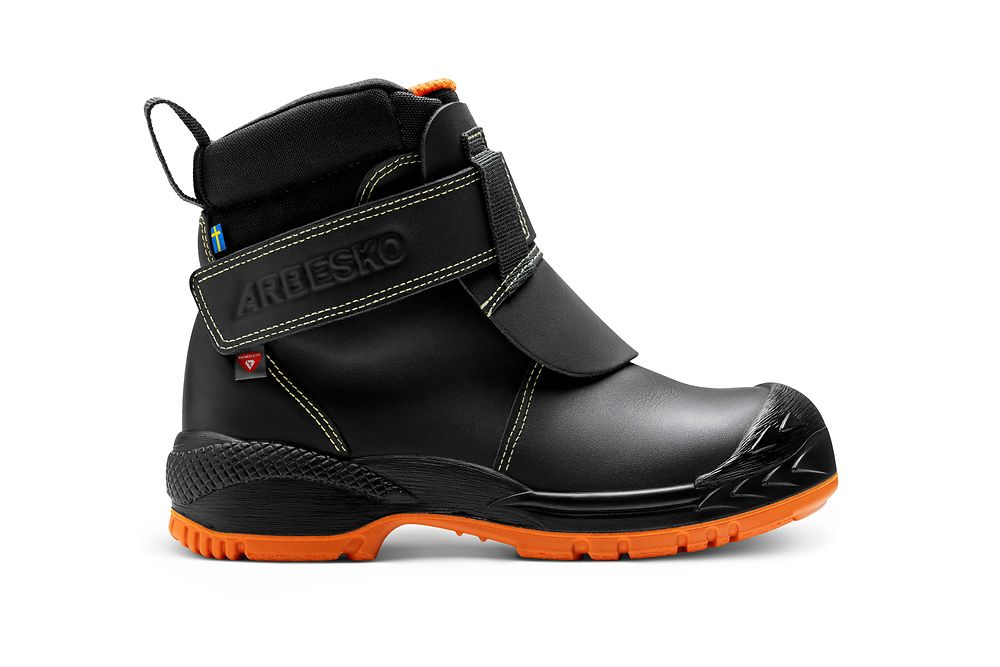
Part 2: welding (EN ISO 20349-2) For welding and similar work with small splashes. The upper is tested against molten metal splash and marked WG. At least an ankle boot.
Part 2 is not a lighter version of part 1. They are tested against different risks. Footwear certified to part 2 is not tested against large amounts of molten metal, and a low shoe cannot be certified to either part.
How the footwear is built
The standard sets requirements for the design, not just the materials. Molten metal must not be able to get caught on the footwear or run into it.
No details on the front of the footwear that can catch molten metal.
No upward-facing seams where metal can collect.
A one-piece vamp.
The tongue fully covered by the upper.
Foundry footwear to part 1 has further requirements: the shaft must be adjustable to fit closely around the leg, metal fittings and rivets must be covered, and the footwear must come off in no more than five seconds while wearing welding gloves. If metal does get into the footwear, it must come off quickly.
The markings explained
The footwear is marked with the number and year of the standard, for example EN ISO 20349-2:2017, followed by the marking codes. These are the ones specific to hot environments.
WG The upper withstands small splashes of molten metal during welding. The test requires at least 25 droplets before the temperature inside has risen by 40 °C. Basic requirement in part 2.
Fe / Al The footwear withstands large amounts of molten iron (Fe) or aluminium (Al) without metal penetrating. Basic requirement in part 1.
HRO Heat-resistant outsole. The outsole material must not collapse after one minute of contact at 300 °C. Basic requirement in both parts.
HI Heat-insulating outsole, tested on a hot surface for 30 minutes. Optional in part 2.
The footwear must also carry the symbol for protection against heat and flame.
Why does new footwear say SRC?
The SRC slip resistance marking was removed from EN ISO 20345 when the standard was updated in 2022. But EN ISO 20349 is still based on the 2011 edition, so the older codes apply here.
SRC, WRU and P on footwear certified to EN ISO 20349:2017 are therefore not a mistake. That is how the standard reads until it is revised. Read more about the 2022 changes in our Guide to safety footwear.
All the equipment counts
The footwear protects best when it works together with the rest of your protective equipment.
Trousers or gaiters should go over the footwear and cover at least down to the ankle, so that metal does not run down into the shaft.
The trousers must not stop the footwear from coming off quickly.
Do not use the footwear if it is contaminated with oil or other flammable substances.
Check the footwear before use, and do not use it if it is damaged.
When should the footwear be discarded?
The standard states when footwear for hot environments no longer gives full protection. Replace it if you see:
Burns, melt damage, blisters or split seams.
Deep cracks in the upper, through half the thickness of the material.
The outsole coming away from the upper.
Cracks in the outsole, or a tread depth below 1.5 mm where the foot flexes.
A badly deformed insole.
Our footwear for hot environments
The Oxelösund series is made for welding and hot work in heavy industry. The 550 high-leg boot and the 650 boot are certified to EN ISO 20349-2 for welding. The 701 and 710 are safety shoes to EN ISO 20345 with a heat-resistant and heat-insulating outsole, for hot work where the welding standard is not required.
Not if there is a risk of welding spatter. An S3 shoe to EN ISO 20345 is not tested against molten metal. For welding there is EN ISO 20349-2, and the footwear is then marked WG.
What does HRO mean?
That the outsole is heat-resistant. The outsole material must not collapse after one minute of contact at 300 °C. It says nothing about how hot it gets inside the footwear, which is what HI is about.
What is the difference between HRO and HI?
HRO means the outsole itself withstands the heat. HI means the outsole insulates, so that your foot does not get too hot when you stand on a hot surface.
Does welding footwear protect against electric shock?
No. Footwear to EN ISO 20349 is not electrically insulating and does not replace footwear to EN 50321-1.
Why should the trousers go over the footwear?
So that molten metal and spatter do not run down into the shaft. The trouser leg sends the metal over the footwear instead of into it.
We are currently working on upgrading the Partner Portal with new features and an improved user experience. During this time, the portal will be temporarily unavailable.
We apologise for any inconvenience this may cause and are happy to assist you via email: